
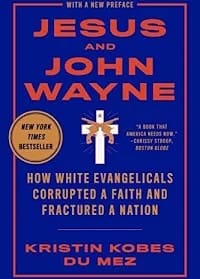
I recently finished a book called Jesus and John Wayne, by Kristin Kobes Du Mez. In the book, Du Mez provides an historical overview of White American Evangelicalism from around the 1950s to 2020, when it was published. She details how ideas of “rugged masculinity” sparked a cultural shift in the evangelical movement, and what influence these ideas have had on American society, culture, and politics as a whole.
Let me tell you right now that some of you would love this book and others will not appreciate it as much. This is not a book recommendation as such (though I found it fascinating), but rather reflections on how I see the writings in this book speaking to our current moment.
In the book, Du Mez discusses times when leaders within the evangelical movement used other people’s race or ethnicity as a means for inciting fear and violence towards entire groups of people. In fact, these acts of “othering” were used to scare evangelical Christians into voting for particular candidates or parties who would “protect” them from the infiltration of “Sharia Law” or “Socialism.” They found that without this sense of existential dread, it was hard to manipulate people into voting in the ways that kept “their people” in power.
I suppose it was both a comfort and a disappointment to see that the same “boogey-men” are finding their way into our cultural dialogue today. Comforting, because there are people who have been warning us of the societal ills that will come by placing “the other” in charge, yet knowing we have not been overtaken by any non-democratic group yet. Disappointing in that I wish we were beyond the othering and fear-mongering that have come to define Christianity for many people over the last few decades.
Over the last year, I have also been a part of an “America 250” bookclub, through which I read four books that represent different aspects of American life and culture over the last 250 years. The thread I found woven across all these books was the ever-evolving nature of what it means to be American and how the influence of different races, ethnicities, and cultures have made this country more beautiful and vibrant. The books we read did not ignore the more difficult journeys we have walked as Americans, but in the end, the diverse expressions of what it means to be an American contributed to a more vivid tapestry. And each book reminded me that this tapestry is still a work in progress.
As we enter the new year, I pray that we will be people who do not allow fear to guide our interactions with one another or our leaders. That we will recognize that there is always someone out there who wants us to be afraid of another person/people group, but that in the end, we are all children of God – beloved and beautiful.
